ICAR 2026 Workshops
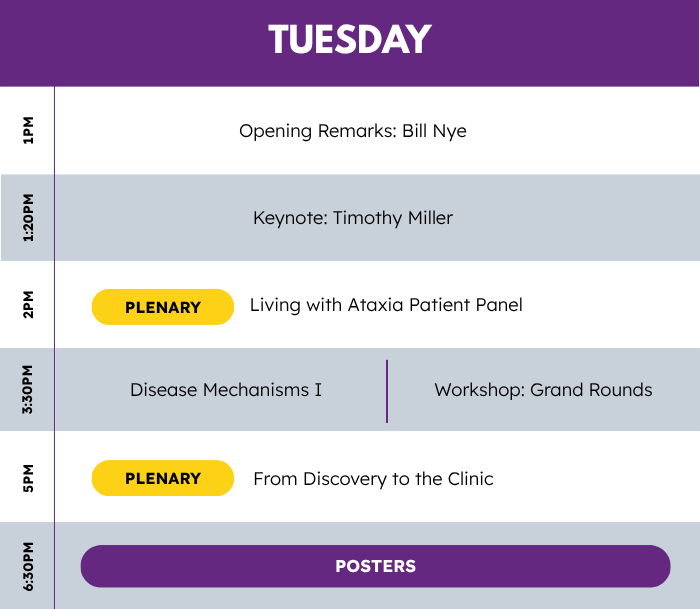
Tuesday Nov 10, 2026
3:30 – 5:00PM
Grand Rounds – Clinical Aspects/Treatment
Moderators: Vikram Shakkottai, Bernard Brais & Bart van de Warrenburg
This session will present 11 cases of ataxia patients by expert clinicians and discuss pathogenic mechanisms and treatment strategies.
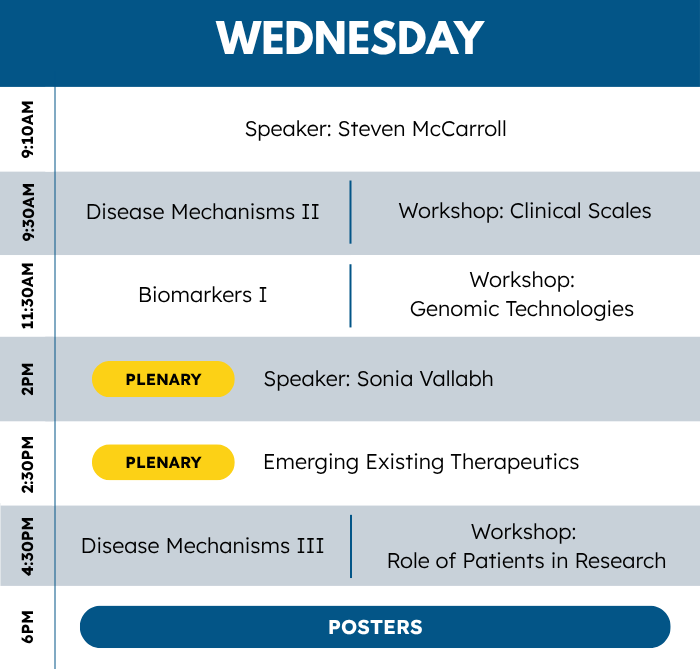
Wednesday Nov 11, 2026
9:30AM – 11:00AM
Clinical Scales Workshop: Updates and tips for a reliable ataxia scoring (Junior Investigator Workshop)
Moderators: Clara Rentz & Pablo Iruzubieta
This workshop presents key updates and practical guidance for reliable ataxia scoring in research (CCAS, mFARS, SARA, SARAhome). Attendees will be invited to score real case examples through live audience scoring, common challenges will be highlighted, and experts will discuss the results.
11:30AM – 1:00PM
Use of Genomic Technologies in Inherited Ataxias
Moderators: Stephan Züchner, David Pellerin & Sanjay Bidichandani
Inherited ataxias remain diagnostically challenging because repeat expansions, complex structural variants, and noncoding variants may be missed or incompletely characterized by routine genetic testing. Even after a causal variant is identified, repeat architecture, somatic instability, and other genetic modifiers can influence age at onset and disease progression. Through focused presentations and interactive case-based discussions, this workshop will examine how novel genomic technologies continue to improve the ability to identify new genes and pathogenic variants, to efficiently perform genetic testing, and to decipher the pathophysiology of inherited ataxias. This workshop will also highlight new developments in genomic technologies, and discuss ways in which they continue to advance research and clinical management. Finally, it will discuss how modifier studies and collaborative datasets can improve prognostication and the development of targeted therapies.
4:30PM – 6:00PM
The Essential Role of Patient Voice in Ataxia Research
Moderators: Julie Greenfield, Celeste Suart & Maureen Juip
The most important expert in ataxia research and drug development may not have a lab, but their insights are reshaping how treatments get discovered and developed. This session unites perspectives from across the research and development spectrum to make the case that patient engagement is not just good ethics, it's good science, and it's relevant to every role in this room.
- Explore how basic scientists are integrating patient perspectives from the earliest stages of research to ensure their work is informed by the lived experience of the disease.
- Hear from industry and regulatory experts on how the patient experience is reshaping trial endpoints, study design, and benefit-risk assessments.
- Walk away with a framework for how your own work, regardless of your role, can better reflect and integrate the patient perspective.
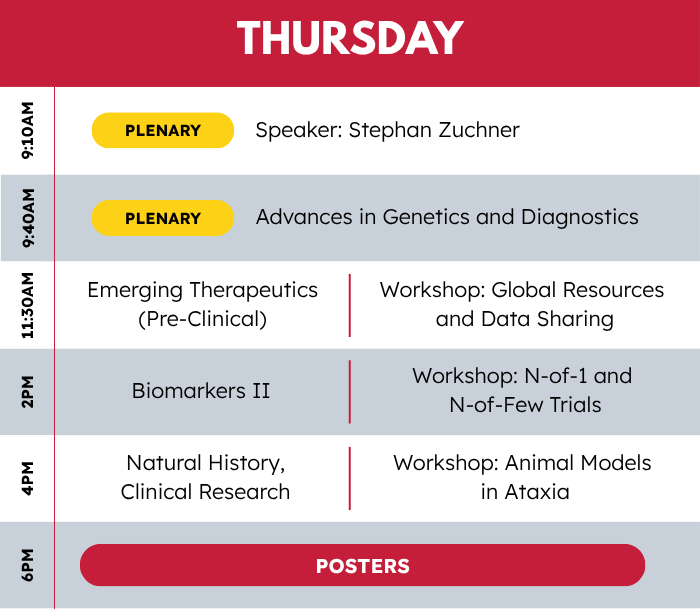
Thursday Nov 12, 2026
11:30AM – 1:00PM
Global Resource and Data Sharing: From Silos to Solutions
Moderators: Gulin Oz and Marek Napierala
International collaborations to share data and resources are essential to facilitate research and clinical trials needed to identify new therapies for rare diseases like ataxias. In this workshop experts who share resources, human data, and specimens in successful international collaborations, while adhering to the multitude of privacy regulations across institutions and countries, will share their knowledge and experiences. A panel discussion with representatives from academia, patient advocacy organizations and specimen repositories will highlight solutions to accelerate international cooperation in ataxias.
2:00 – 3:30PM
Establishing Robust Evidence for Aggregated N-of-1 and N-of-Few: Master Protocols and Analysis Designs to Advance Development of Individualized Medicines at Scale
Moderators: Matthis Synofzik & Bart van de Warrenburg
Current opportunities for individualized antisense oligonucleotide (ASO) therapies put genetic ataxias at the frontier of precision medicine. In the absence of a classic cohort to power a standard trial, there is an urgent need to find innovative ways for single-patient therapies to lead to regulatory-ready evidence. This session explores how the field can move from one-off, named-patient cases toward master protocols and aggregated N-of-1/N-of-few designs that generate evidence across genetically defined subgroups for aggregated analyses. Drawing on live experience from ataxia telangiectasia and other rare neurological diseases, speakers will unpack how the FDA and the UK's emerging MHRA pathways evaluate run-in periods, patient comparisons, and harmonized outcomes — including when to lump vs. split diseases within an umbrella protocol. With regulatory experts alongside investigators who are preparing such protocols in real time, we expect to move beyond first theoretical concepts to direct regulatory insight and design principles to build into our next N-of-1/N-of-few efforts.
4:00 - 5:30PM
Animal models in ataxia: scientific value in a changing research landscape (Junior Investigator Workshop)
Moderators: Jacen Emerson and Marta Moya Jodar
Featuring experts in a broad range of ataxia models, this workshop will discuss the strengths and weaknesses of these models with a panel style forum. We will also debate the best ways to defend animal models in grants as funding agencies are shifting away from their use.
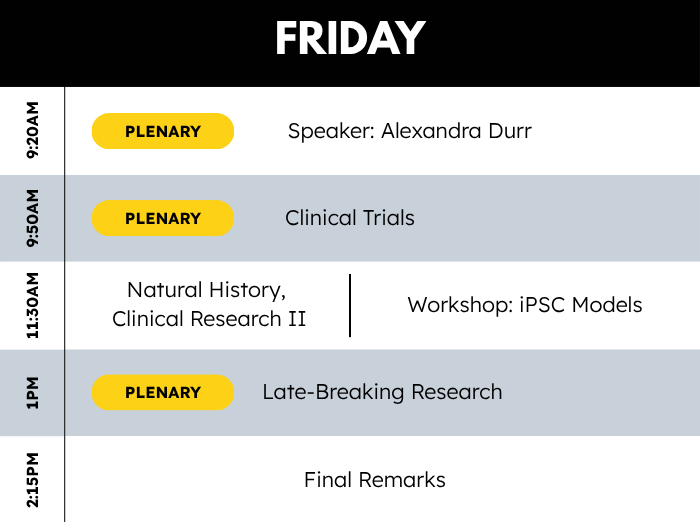
Friday Nov 13, 2026
11:30 – 1:00PM
iPSC-based disease modelling for ataxias
Moderators: Helene Puccio, Mirella Dottori, Ronald Buijsen
Induced pluripotent stem cell (iPSC)-based technologies have transformed disease modelling for neurodegenerative disorders, including the ataxias. Starting from patient-derived iPSCs, researchers can now generate a wide spectrum of in vitro systems, ranging from 2D neuronal cultures to increasingly sophisticated 3D models such as organoids, assembloids, and multi-region brain-like structures. More recently, integration with microfluidic platforms has enabled the development of “brain-on-a-chip” systems, offering unprecedented control over cellular environments and inter-regional connectivity. These advances provide powerful tools to recapitulate aspects of human brain development and disease in ways that were previously inaccessible.
Despite these exciting developments, key questions remain regarding the optimal use and interpretation of these models. Increasing model complexity promises greater physiological relevance but also introduces challenges in reproducibility, scalability, and data interpretation. At the same time, genetic variability inherent to patient-derived cells complicates comparisons across studies, raising concerns about robustness and standardization.
This workshop aims to critically evaluate the current landscape of iPSC-based disease modelling for ataxias and to define priorities for the field. In particular, we will address the following questions:
- What level of model complexity is actually necessary, and when?
- How do we deal with genetic variability and reproducibility in iPSC models?
- What are iPSC models actually good for: mechanisms, drug discovery, or biomarkers?
- Are iPSC-based systems ready to replace (or reduce) animal models in ataxia research?
- What are the biggest technical and conceptual gaps and how do we fix them?